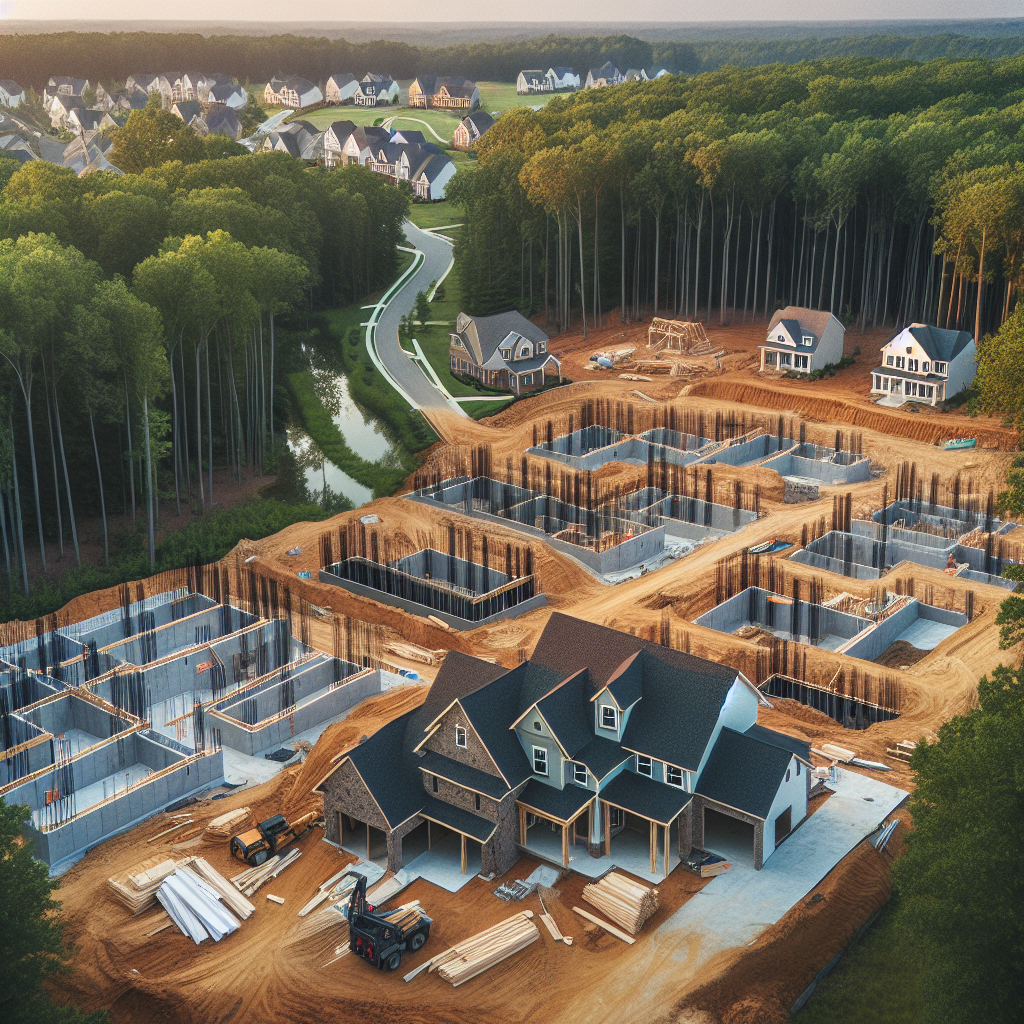
North Carolina is the Southeast's fastest-growing residential market outside of Florida and Texas. Driven by corporate relocations to the Research Triangle, a booming financial sector in Charlotte, and a cost of living that remains favorable relative to coastal metros, the state has sustained strong population and housing demand for the better part of a decade — and that demand isn't slowing down.
For builders, NC offers a genuinely builder-friendly regulatory environment: no state-level permit pre-emption, a code framework derived from the IRC (International Residential Code), and impact fees that are meaningfully lower than comparable Florida markets. But "builder-friendly" doesn't mean frictionless. Permit timelines vary significantly across the 18 jurisdictions ZoneIQ tracks, and Charlotte's 2023 UDO introduced a wave of new zoning complexity alongside expanded opportunity.
NC Market Overview 2026
North Carolina's residential construction activity is concentrated in two major metro corridors — the Charlotte Metro and the Research Triangle — with secondary activity in the Triad (Greensboro–Winston-Salem) and coastal markets. Understanding which corridor you're targeting shapes every downstream decision, from land acquisition to permit strategy.
Charlotte Metro
The Charlotte Metropolitan Statistical Area issued 22,000+ residential permits in 2025, representing +18% growth year-over-year — the highest raw volume in the state. Mecklenburg County sits at the core, surrounded by high-growth suburban counties including Cabarrus (Concord, Kannapolis), Union, Gaston, and Iredell. Charlotte's in-migration is fueled by financial services, tech, and healthcare sector expansion, with major corporate relocations continuing through 2025–2026.
Research Triangle (Raleigh–Durham–Chapel Hill)
The Triangle issued 14,000+ residential permits in 2025, up +11% year-over-year. Wake County (Raleigh, Cary) leads volume; Durham County has seen accelerating growth tied to the biotech and university economy. The Triangle attracts a highly educated buyer demographic with strong median incomes, supporting higher price points and lower mortgage risk for builders focused on move-up product.
Triad and Coastal Markets
The Triad — Greensboro and Winston-Salem — offers more affordable land costs and a stable if slower-growth demand base. Coastal markets (Wilmington, the Outer Banks) carry additional regulatory complexity from FEMA flood zone overlays and hurricane-rated construction requirements, which add cost and review time relative to inland jurisdictions.
NC carries less regulatory burden than Florida (no concurrency, lower impact fees, simpler wind codes) while delivering more market scale than Alabama or South Carolina. For builders evaluating Southeast expansion, it's the strongest risk-adjusted opportunity in the region. View NC housing starts data →
North Carolina Permitting Process
Local Control — No State Pre-emption
North Carolina does not operate a state-level building permit system. Permits are issued by individual municipalities and counties. Each of ZoneIQ's 18 tracked NC jurisdictions runs its own plan review operation, maintains its own fee schedule, and sets its own staffing levels. There is no state pre-emption that would override local permitting timelines or procedures.
What is uniform statewide is the applicable code: the NC Residential Code (NCRC), which is based on the International Residential Code (IRC) with North Carolina amendments. NCRC adoption ensures a consistent structural and fire safety baseline, but it does not standardize the permitting process itself.
Standard Process
The typical residential single-family permit in North Carolina follows this sequence:
- Zoning compliance review — Confirm the lot is properly zoned, meets minimum lot size, setback, and height requirements under the applicable municipal or county UDO.
- Plan review — Structural review (foundation, framing), fire review (egress, smoke/CO detectors), and zoning dimensional review. Some jurisdictions run these concurrently; others run sequentially, which adds time.
- Permit issuance — Fee payment and permit card issued. Most jurisdictions now offer online payment and digital permit cards.
- Inspections — Foundation, framing, rough-in MEP (mechanical, electrical, plumbing), insulation, and final inspection. Order varies slightly by jurisdiction.
- Certificate of Occupancy (CO) issuance — Issued after passing final inspection. Required for occupancy and triggering the closing timeline.
Typical Timelines by Market
The table below reflects ZoneIQ's tracked data for plan review and total permit timelines across major NC jurisdictions. "Total days" represents plan review plus standard administrative processing time. Active construction time is not included.
| Jurisdiction | Plan Review | Total Days | Online Submission? |
|---|---|---|---|
| Charlotte | 35–45 days | 45–65 days | Yes |
| Raleigh | 28–40 days | 38–55 days | Yes |
| Durham | 30–42 days | 42–55 days | Yes |
| Cary | 25–35 days | 35–48 days | Yes |
| Concord | 25–35 days | 38–50 days | Yes |
| Kannapolis | 22–32 days | 35–48 days | Yes |
| Gastonia | 28–38 days | 40–55 days | Partial |
| Greensboro | 35–50 days | 48–68 days | Yes |
| Winston-Salem | 30–45 days | 42–60 days | Partial |
Jurisdictions with partial online submission still require paper plan sets for structural review, which introduces a 3–7 day delay in intake compared to fully digital pipelines. Charlotte's periodically longer timelines are a staffing issue, not a process design issue — during peak volume quarters, review queues can extend beyond published estimates.
NC Building Permit Fees
Permit Fee Structure
North Carolina permit fees are calculated based on construction value — either as a percentage of total declared project value or on a per-square-foot valuation table set by each jurisdiction. For a typical single-family home in the $350,000–$500,000 construction value range, permit fees (excluding impact fees) fall in the $400–$900 range across most NC jurisdictions. This is notably lower than Florida markets, where permit fees often exceed $1,200 for comparable projects.
Some jurisdictions charge plan review and permit issuance as separate line items; others bundle them. Always request a fee estimate itemization before submitting, as bundled-versus-separated structures can affect your accounting and timeline expectations.
Impact Fees by Market
Impact fees in North Carolina are assessed by county and fund schools, roads, parks, and utility infrastructure. They are lower than most major Florida metros and competitive with comparable Texas suburban markets. The table below reflects current ZoneIQ data for major NC jurisdictions on a per-single-family-home basis.
| Market | Schools | Roads | Parks | Utilities | Total |
|---|---|---|---|---|---|
| Charlotte (Mecklenburg) | $1,600 | $600 | $300 | $250 | $2,750 |
| Raleigh (Wake County) | $1,800 | $700 | $350 | $300 | $3,150 |
| Durham (Durham County) | $1,500 | $580 | $280 | $240 | $2,600 |
| Cary | $1,700 | $650 | $320 | $280 | $2,950 |
| Concord / Kannapolis | $1,400 | $550 | $260 | $220 | $2,430 |
For builders running 50–200 homes per year, the difference between Concord/Kannapolis ($2,430) and Wake County ($3,150) represents $36,000–$144,000 in annual impact fee savings at equivalent volume. When land costs between these markets are similar, that delta is meaningful at the margin.
NC Zoning — Key Considerations
Common SF Districts
Most North Carolina municipalities use an R-3, R-4, or R-MH single-family zoning designation, though naming conventions vary across jurisdictions. Typical minimum lot sizes range from 6,000 to 10,000 square feet in urban and suburban districts, with larger minimums in low-density residential or agricultural transition zones.
Standard dimensional requirements across NC SF districts include:
- Front setback: 20–30 feet from right-of-way
- Side setback: 5–10 feet per side
- Rear setback: 20–25 feet
- Maximum height: 35 feet in most jurisdictions
- Impervious surface limits: 45–60% coverage in most urban SF zones
Charlotte's 2023 UDO — Builder Opportunity
Charlotte's Unified Development Ordinance (UDO), which went into effect in 2023, is one of the most consequential zoning changes in the Southeast in the past decade. The UDO replaced Charlotte's previous Zoning Ordinance and introduced significant density allowances in previously single-family-only areas of the city.
Key changes affecting builders:
- Missing middle housing: Duplexes, triplexes, and quadplexes are now permitted by-right on lots previously limited to a single detached home across broad swaths of the city.
- Infill opportunity: Older single-family neighborhoods close to employment centers and transit corridors are now viable for 2–4 unit infill development with no rezoning required.
- ADU allowances: Accessory Dwelling Units are permitted by-right in all residential districts, adding a bonus unit to eligible single-family lots.
- Reduced parking minimums: Minimum off-street parking requirements were reduced or eliminated near transit corridors, lowering land cost per unit for attached product.
Charlotte's UDO is one of the most significant upzoning events in Southeast history. Infill builders have an expanded opportunity window that did not exist before 2023. If you're not actively evaluating in-town Charlotte lots under the new density framework, your competitors likely are.
Easiest vs. Hardest NC Markets
ZoneIQ's friction scores aggregate permit timeline, plan review consistency, staff responsiveness, fee predictability, and online submission capabilities into a single 1–10 score (lower = less friction). The table below covers the major NC markets in ZoneIQ's tracking database.
| Market | Friction Score | Best For | Key Challenges |
|---|---|---|---|
| Kannapolis | 5.0 | Speed, low cost | Smaller demand pool |
| Durham | 4.9 | Research Triangle demand | Rising land competition |
| Cary | 5.1 | Premium buyer market | Higher land costs |
| Charlotte | 5.5 | Volume, large market | Periodic staffing delays |
| Winston-Salem | 5.6 | Less builder competition | Smaller demand base |
| Greensboro | 5.8 | Affordable price points | Slower plan review cycles |
Durham's low friction score combined with strong Research Triangle demand makes it a standout value for builders who want low process friction in a high-demand submarket. Kannapolis is the fastest-processing jurisdiction in ZoneIQ's NC dataset, though builders should model lot absorption carefully given the smaller addressable buyer pool. Greensboro's longer plan review cycles — up to 50 days for plan review alone — make it the highest-friction major NC market despite competitive land costs.
Compare All 18 NC Jurisdictions on ZoneIQ
Friction scores, permit timelines, and impact fee breakdowns — side-by-side for every tracked NC market.
View NC Jurisdiction Comparison →Builder Tips for NC
Based on ZoneIQ's permit data and jurisdiction analysis, here are the highest-leverage actions for builders operating in North Carolina in 2026:
Prioritize Charlotte Infill Under the UDO
Charlotte's 2023 UDO created a multi-year window for infill builders to acquire single-family lots in established in-town neighborhoods and develop 2–4 unit product by-right. This type of by-right density — no rezoning, no variance, no discretionary approval — is rare in Southern metros. The window narrows as more builders and developers recognize the opportunity and land prices adjust. Act before the arbitrage closes.
Target Charlotte's Western Suburbs for Volume
Concord and Kannapolis in Cabarrus County offer the fastest permit timelines and lowest impact fees in the Charlotte metro. For builders running volume production with tight pro formas, the western suburbs' combination of speed (35–48 day total timelines), low fees ($2,430/unit), and strong Charlotte spillover demand makes them the highest-efficiency NC submarket for volume production. The I-85 corridor between Charlotte and Concord has absorbed significant demand from buyers priced out of Mecklenburg County.
Research Triangle for Demand Quality
The Triangle (Raleigh–Durham–Chapel Hill) offers the strongest demographic tailwinds in the state. A highly educated, high-income buyer base, continued corporate in-migration, and proximity to Duke, UNC, and NC State creates persistent demand across price points. Durham's low friction score makes it particularly attractive. Cary remains the premium submarket with the most reliable demand for move-up product in the $500,000–$800,000 range.
Eastern North Carolina coastal markets (including the Outer Banks, New Bern, and Morehead City) carry significant regulatory complexity from FEMA flood zone overlays, CAMA (Coastal Area Management Act) permitting, and hurricane wind zone requirements. These add meaningful cost and review time compared to inland jurisdictions. Unless you have specific coastal expertise and a buyer pool that values waterfront premium, these markets are not appropriate for standard production homebuilding operations.
Pre-Application Meetings Save Time
Charlotte, Raleigh, and Durham all offer pre-application meetings with plan review staff before formal submission. These meetings — typically 30–60 minutes — allow you to surface zoning or code compliance issues before the clock starts on your plan review period. Builders who skip pre-application meetings in Charlotte report 15–20% higher revision rates, which add 10–14 days to average timelines. The meeting cost is zero; the time savings are real.
Online Submission Is Now Baseline
Every major NC jurisdiction in ZoneIQ's dataset now offers full or partial online permit submission. Builders still submitting paper plans in markets with digital intake (Charlotte, Raleigh, Durham, Cary, Concord, Kannapolis) are adding unnecessary delay to their review queue. If your team is not yet fully on digital submission workflows, prioritize the transition — it is no longer optional in competitive NC markets.